
The review desk
Four feeds, game state and live metrics, run by one operator.
Photographed at a national-level test in March 2025. The on-screen banner is the CritShot call for that delivery.

What the operator sees
Four panels, one screen, one person.
01
Feed manager
Up to four camera feeds in, with the active broadcast angle selected for the model. Thumbnails of every feed run along the top.
02
Video manager
Frame-accurate playback of the delivery under review, so the operator can confirm what the model saw before a call goes to air.
03
Game state manager
Balls, runs and extras for the innings. Game state feeds the shot model: the right shot on ball 3 of over 2 is not the right shot on ball 6 of over 19.
04
Aggression metrics
A live aggression score and run-rate trend for the batter at the crease, updated every delivery and available to the commentary team.
A DRS day today
15 to 20 people on site.
Camera operators, analysts and a truck, travelling with the fixture.
$21,000 a day.
A DRS day rate runs $20,000 to $30,000 before logistics.
With Chrio
One machine. $0 in logistics.
Detection, prediction, render and output run on a single workstation at the ground.


Detection mode: the feed as the model sees it.
Player and pitch boxes, a movement vector, and the game state feeding the shot model.
How a call is made
From delivery to overlay before the next ball.
- 01
Detect. Ball, batter, bowler, fielders and pitch are located on every frame by three detectors voting in parallel.
- 02
Read the delivery. Line, length, speed and field placement are combined with the game state into a single feature set.
- 03
Predict. An LSTM and XGBoost stack picks the highest-value shot for that delivery and scores its difficulty from 1 to 10.
- 04
Render. Blender animates a 3D avatar playing that shot from the broadcast angle, beside the shot actually played.
- 05
Air. The operator approves and the overlay leaves the workstation as an NDI stream, ready for the replay slot.
Intelligent analysis
Six readings on every ball, before the call is made.
- 98.6% accuracy
Ball identification
High-precision detection and tracking of the ball from release to the bat, on a broadcast feed.
- 15+ features
Complexity profiling
Spin, speed, swing, seam and more than a dozen other features extracted from the delivery.
- Live radar
Field density mapping
Fielder placement and density mapped live, so the recommended shot is the one that finds the gap.
- Live context
Match context awareness
Over, phase of the innings, required rate and intent are all part of the model’s input.
- Stress levels
Batsman stress index
An estimate of the pressure on the batter and how hard the decision in front of them is.
- 10k+ deliveries
Proven on data
Validated on more than ten thousand deliveries of professional match footage.
CritRate · In development
1 to 10. Per player, per match.
Computed from in-game performance data as the match runs, with no manual input. Built on the same detection and event pipeline as CritShot, trained on the same 30 TB dataset from PSL, National T20 and Tri-Nation cricket.
Each bar is one rating band; the marked band is where the current innings sits.

CritDRS · In development
Review decisions from the same feed.
Where the ball landed, relative to the line of the stumps. Reconstructed from the tracked trajectory rather than a single camera angle.
Ball tracking is already built and shared with CritShot; collision detection and multi-view fusion are the current focus.

The prototype · Hawkeye-X
Every delivery detected, its full flight reconstructed in 3D.
The pre-MVP rig behind CritDRS. Three calibrated cameras, synchronised to 0.0 ms drift, feed a vision engine running at 50 fps that reconstructs each ball's flight in three dimensions: release, pitching, impact and projected path, with live speed.
The proposed umpire workflow runs on one device. Glasses capture every ball, the stream syncs to the umpire's tablet, the tracked delivery plays back in the review centre, and a three-check verdict goes to the broadcast and the scorecard together.
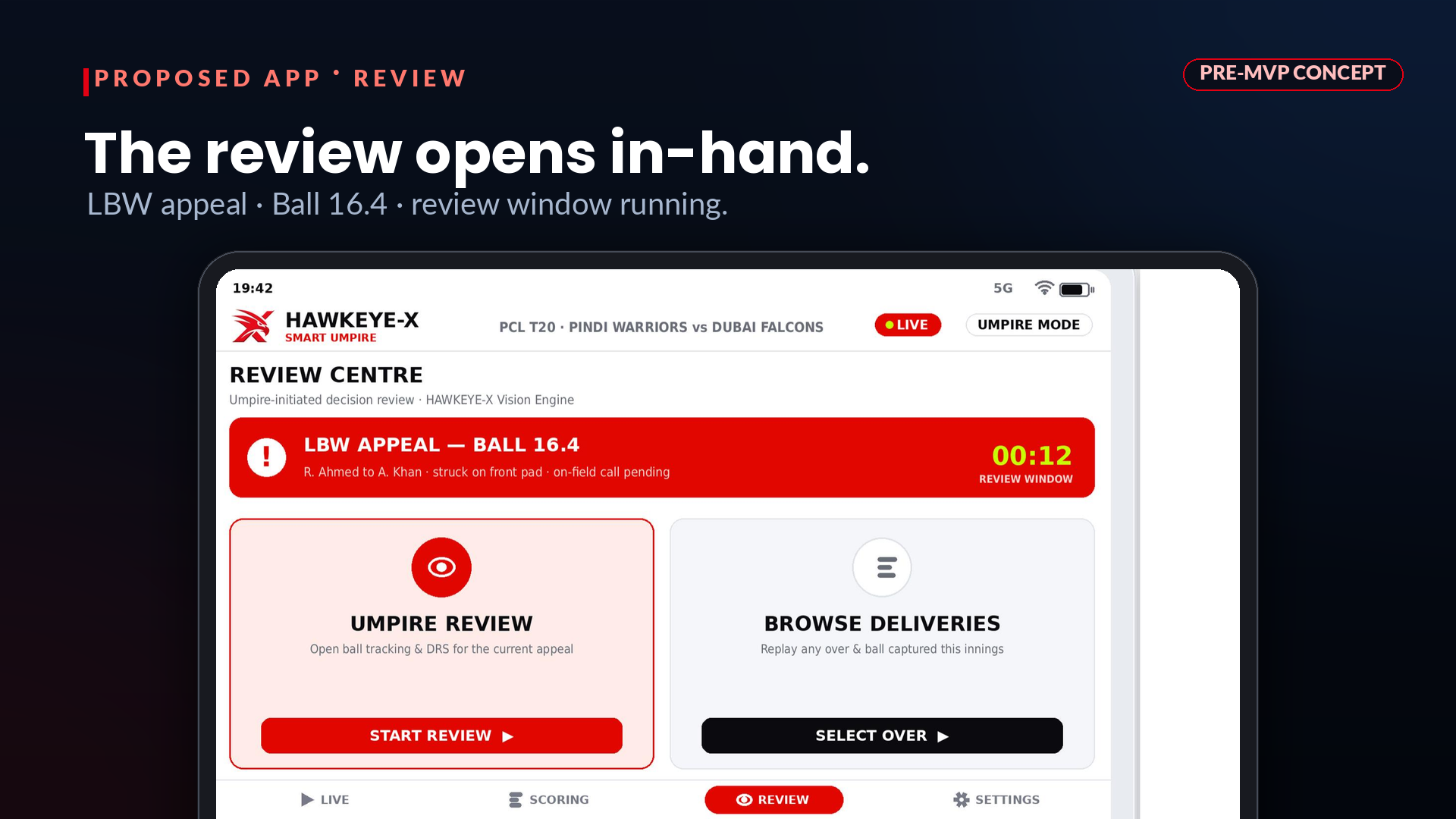
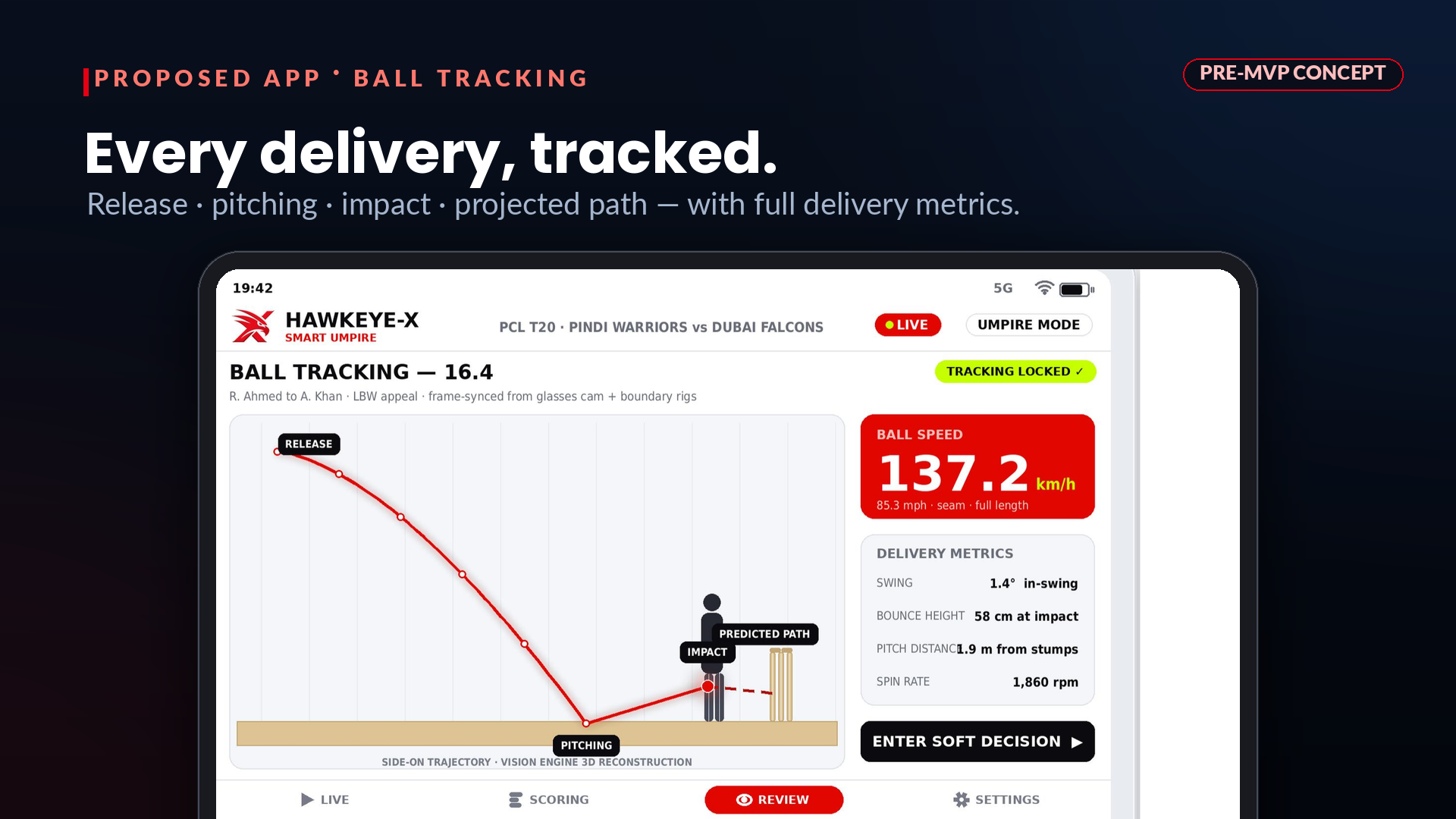
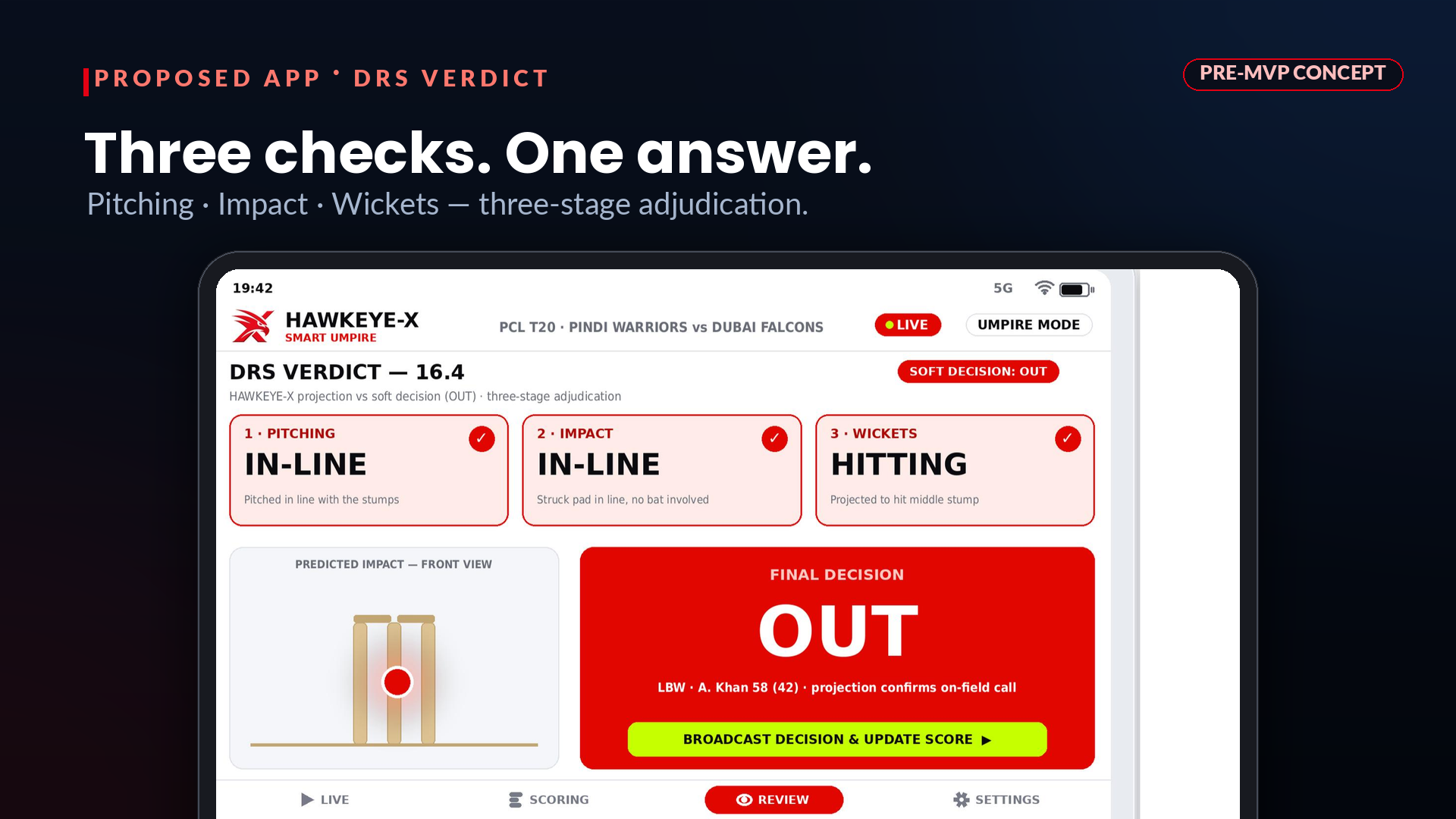
App screens are pre-MVP concepts with fictional teams and players. The trajectory reconstruction and telemetry are from the working test rig.
One pattern, two products
Fan out in parallel, reconcile what comes back, answer under a deadline.
CritShot runs YOLOv8, YOLOv11 and Detectron2 as a parallel consensus ring with SAHI recovery for what the ring misses, and holds 1.5 ms. Dhundo dispatches one query to 136 store adapters across three independent scraper fleets, then reranks what returns in two stages — a bi-encoder for recall, a cross-encoder for precision — so total latency is the slowest store rather than the sum of all of them.
Cricket and commerce are not two businesses that happen to share a founder. They are the same engineering problem answered twice.
The pipeline · stage 1 of 6
-
01
Feed in
The broadcast or camera feed lands on the machine at the ground over NDI or SDI capture; no truck, no uplink.
-
02
Three detectors vote
YOLOv8, YOLOv11 and Detectron2 run in parallel on every frame; a detection is kept only when the ring agrees.
-
03
SAHI catches what they missed
When the ball is too small for a full-frame pass, sliced inference recovers it before the track breaks.
-
04
Trim, then predict
An LSTM interpolates gaps in the trajectory; XGBoost classifies the shot and scores its difficulty.
-
05
Render
The recommended shot is posed on the 3D batter and rendered in Blender, in the broadcast’s own kit.
-
06
NDI out
The overlay leaves as an NDI stream. Chrio rewrote the only Python NDI library available and removed a critical memory leak in it.
Models trained with TensorFlow and Roboflow, served on Nvidia GPUs, written in Python.




Tooling credits, not partnerships. Model accuracy detecting cricket gameplay artifacts: 98.67%.
Evolution
From 20.95% to 98.67% in twelve months.
Five model versions between September 2024 and September 2025, a 470% improvement in detection accuracy. The training set grew to 30 TB of PSL, National T20 and Tri-Nation footage along the way.
- V1Sep ’2420.95%—
- V2Dec ’2424.02%+3.07%
- V3Feb ’2535.65%+11.63%
- V4Mar ’2539.87%+4.22%
- V5Sep ’25 · latest98.67%+58.80%
Version 1.0 · September 2024
20.95%
Legacy system. Single detector on recorded footage; proved the idea and little else.
Version 5.0 · September 2025
98.67%
Current production model. 100 ms latency on one Nvidia GPU. Signature 3D model arriving Q1 2026.
For broadcasters
What it takes to run CritShot on your feed.
What hardware comes to the ground?
One workstation with a single Nvidia GPU, two monitors and a capture card. It fits on a folding table in the broadcast box and is set up by the operator who runs it.
What feed do you need from us?
A clean SDI or NDI feed of the broadcast camera behind the bowler’s arm. Additional angles improve the render but are not required for the shot call.
What comes back to the truck?
An NDI stream carrying the finished overlay: the played shot beside the recommended shot, with the difficulty score. Your director drops it into the replay slot like any other source.
How long is setup?
Under an hour from arrival to first overlay, most of it camera calibration against the pitch markings.
Who approves what goes to air?
The operator. Every CritShot call is reviewed on the video manager before release; nothing goes out automatically.
What does it cost compared with a DRS crew?
Roughly 0.15x. A traditional analysis or DRS day runs $20,000 to $30,000 before logistics with 15 to 20 people on site; CritShot brings one person and no truck.
Founders
Two students who built a broadcast product before they graduated.

Co-founder · CEO
Abdullah Zubair Ghouri
Abdullah started Chrio in May 2024, in his second year of computer science at FAST-NUCES Islamabad, after a run of vision-AI hackathon wins convinced him the same models could read a cricket broadcast. He trained the first ball-detection models himself, wrote the Python NDI library that gets Chrio’s overlays into a production room, and then went and found the broadcaster.
He raised $20K on a $1M post-money SAFE, signed the Trans Group partnership, and has taken Chrio through six national competitions in a year. Alongside Chrio he has worked on reinforcement-learning agents for driver safety at Motive and on LLM training at MAVN AI. He graduates in 2026 with a 3.9 GPA, five gold medals and a Mitacs research scholarship to Ontario Tech.
- Founded ChrioMay 2024
- AlsoAI SWE Intern, Motive · LLM Engineer, MAVN AI · VFXGen (#1 on FiVE-Bench, ICCV 2025)
- EducationBS Computer Science, FAST-NUCES, 2022–2026 · 5x Gold Medalist · 7x Dean’s List
- RecognitionGoogle Startup Program winner, $25K · Ignite AI Wrapper runner-up · Mitacs Global Research Scholar
“Every game deserves technology that makes cricket more intelligent, transparent, and exciting. That is the future we are building at Chrio.”abdullahzubair@chrio.site

Co-founder · CTO
Saffi Muhammad Hashir
Saffi is the engineer behind everything Chrio ships. He built the real-time cricket analytics stack that runs at 30 frames per second on one GPU, combining YOLO, Detectron2, SORT and SAHI, and then cut inference latency from 200 ms to 33 ms with CUDA work so the overlay could keep pace with live play.
He also built Dhundo’s distributed search engine, seventeen containerised scraping servers behind a WebSockets front end, and the internal platforms the company runs on. He has led a team of 25 engineers across seven platforms, works as an ML engineer and full stack engineer at Visiontech360, and co-founded a second startup, Repic, in late 2025. He is finishing his computer science degree at FAST-NUCES.
- Joined as CTOJune 2024
- AlsoML Engineer and Full Stack Engineer, Visiontech360 · Co-founder & CTO, Repic · VFXGen (#1 on FiVE-Bench, ICCV 2025)
- StackTensorFlow, PyTorch, YOLO, Detectron2, SAHI, CUDA · Django, FastAPI, React, WebSockets · GCP, Docker, Redis
- EducationBS Computer Science, FAST-NUCES, 2022–present · Meta Front-End Developer · DeepLearning.AI ML
“The best technology becomes part of the game itself. Our goal is to make powerful AI feel instant, reliable, and effortless.”saffimuhammadhashir@chrio.site
Distribution
Trans Group and TPT carry CritShot to a national broadcast.
Trans Group is Pakistan's largest sports business group; Trans Production and Technologies is its production arm.




Google Startup Program winner ($25K), Sept 2025 · Runner-up, HBL P@SHA ICT Awards (Media & Entertainment), Sept 2025 · Runner-up, National Ignite AI Wrapper Award (EdTech), Oct 2025 · Finalist, Prime Minister Pitch Perfect, Nov 2025 · Top 8, Citadel National Pathfinder, Nov 2025 · Vision AI Hackathon winner, Jan 2025. Incubated at NIC Islamabad, NSTP PITB and i2i.
Bring CritShot to your broadcast.
Abdullah Zubair Ghouri, CEO
abdullahzubair@chrio.siteSaffi Muhammad Hashir, CTO
saffimuhammadhashir@chrio.siteIslamabad
Chrio PVT LTD · Plot No. 24-B, Street No. 6, Sector H-9/1, Islamabad, Pakistan