
Product line 01 · Cricket broadcast technology
A review day costs $20,000 to $30,000 before anyone travels.
Decision review and broadcast analysis are built around a crew. Camera operators, analysts and a truck move with the fixture, and the day rate runs $20,000 to $30,000 before logistics, with even a stripped-down four-camera setup starting around $12,000 to $15,000. That economics is why the technology reaches international cricket and stops.
Chrio replaces the crew with software. Detection, prediction, rendering and broadcast output run on one workstation at the ground, operated by one person, at roughly 0.15× the cost of a traditional analysis day. Domestic leagues, regional tournaments and academy cricket become viable broadcast clients. What a review day costs, and what it could cost.
- 15 to 20
- people on a traditional crew
- 1
- operator, one machine, with Chrio
- Under 1 hour
- from arrival to first overlay
- $0
- logistics, no truck, no travel
Three products read the same camera feed through the same detection and event pipeline, trained on 30 TB of footage from PSL, National T20 and Tri-Nation cricket. Improving the tracker improves all three at once.
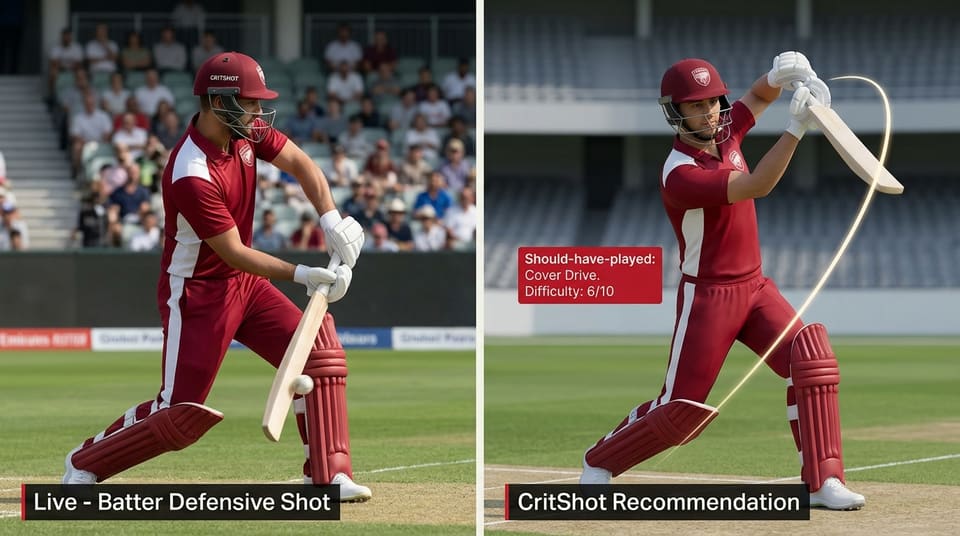
CritShot, live shot analysis overlay
LiveRenders the shot the batter should have played as a 3D avatar inside the broadcast, with a difficulty score for the call. Tested at a national-level fixture, March 2025.
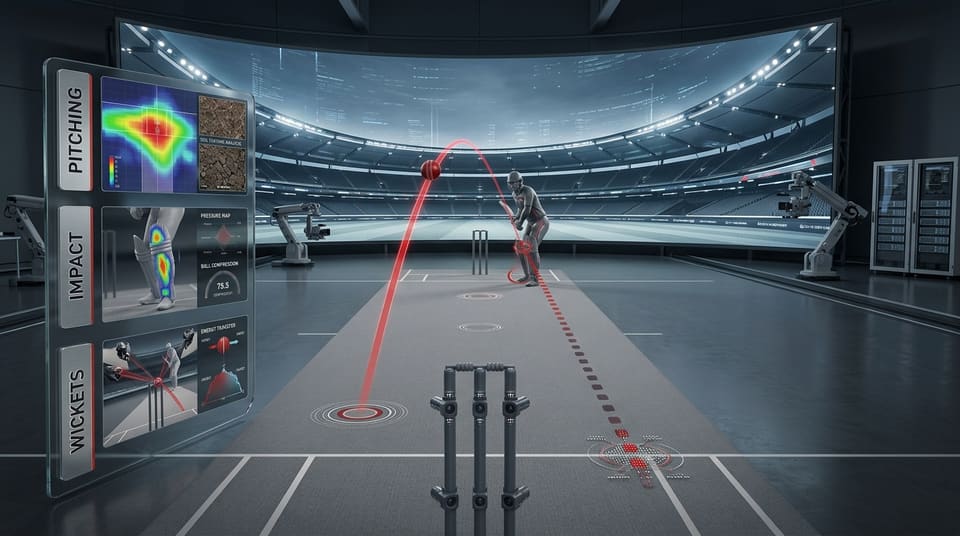
CritDRS, decision review for domestic cricket
In developmentPitching, impact and wickets adjudicated from the same tracked trajectory, without a dedicated review crew. Ball tracking is built; collision detection and multi-view fusion are the current focus.
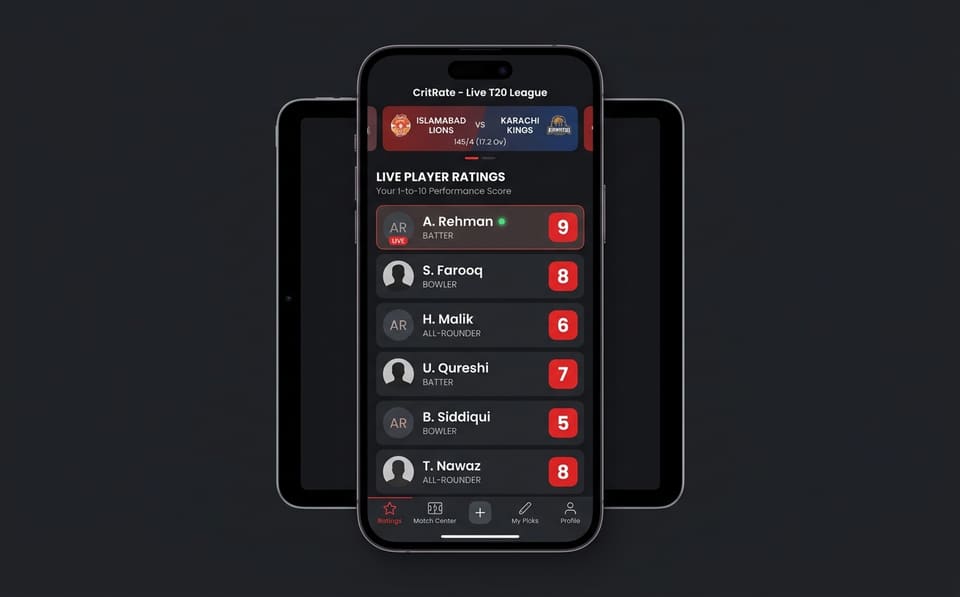
CritRate, live player performance ratings
In developmentA 1 to 10 rating for every player, every match, computed from in-game performance as it happens rather than assembled afterwards by a panel. Concept render; teams and players shown are fictional.
Product line 02 · Commerce
One search reads 136 Pakistani stores.
Dhundo is a product search engine for Pakistan. One query fans out to 136 stores at once and comes back as a single list sorted by price, with the store named on every row. It holds no stock, sells nothing and takes no payment: the transaction is between the buyer and the shop. Most price comparison in Pakistan covers a fraction of that, and the long tail is the point. The single-brand shops that only sell their own catalogue are where the price differences actually live, and they are the ones nobody else indexes.

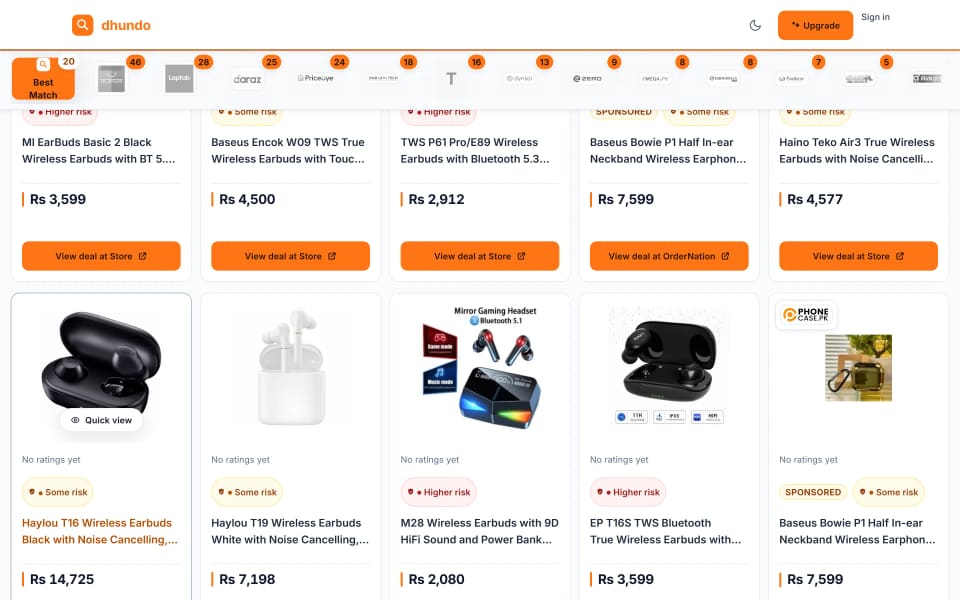
The honesty architecture
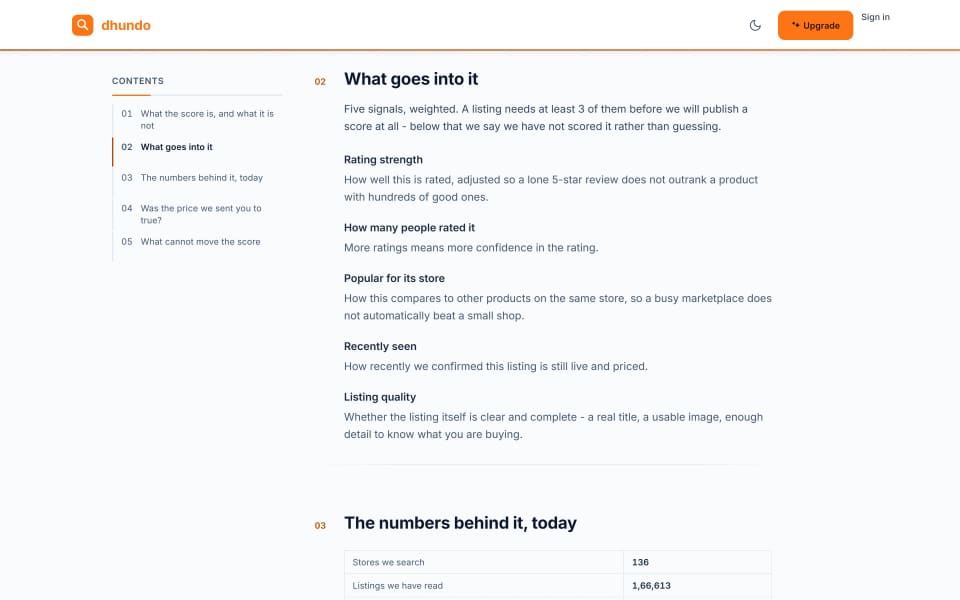
“It is not a customer rating. Nobody has voted on it, and we do not publish it as though they had.”
dhundo.store/how-we-score, on its own scoring
- Fake structured data is banned, and a test enforces the banMost competitors emit synthesised
AggregateRatingfor SEO. Dhundo refuses, and proves it in CI. - Price age is disclosed, not hiddenA price is what the store showed when Dhundo last read it, and the listing says when. Confirm at the store before paying.
- Sponsored placements are labelled, and paying does not move you upThere is a section headed “What cannot move the score”, and it is enforced rather than promised.
Underneath, one query is dispatched to 136 store adapters across three independent scraper fleets in parallel, so total latency is roughly the slowest store rather than the sum of all of them. What comes back is reranked in two stages, a bi-encoder for recall and then a cross-encoder for precision.
- 58,058
- searches run
- Rs 1.26B
- in price differences surfaced
- 133,328
- products ranked from 316,326 listings read
- 971
- users
Figures read from Dhundo’s live stats, fetched 6 September 2026.
How we build
Two product lines, one habit: run everything in parallel, then agree.
Cricket and commerce are not two businesses that happen to share a founder. They are the same engineering problem answered twice, and building one has repeatedly improved the other.
Cricket · detection
YOLOv8, YOLOv11 and Detectron2 run on every frame as a parallel consensus ring. A ball is only a ball when the ring agrees; SAHI sliced inference recovers the ones too small for a full pass.
Dhundo · search
One query fans out to every store at once. Results are normalised and merged into a single price-sorted list before the first store would have finished on its own.
Where a library got in the way, we rewrote it. Chrio rewrote a Python NDI library and removed a critical memory leak in it, and rewrote an assembly-optimised WebSockets library.

Founders
Abdullah Zubair Ghouri
Co-founder. Started Chrio in May 2024 as a second-year computer science student at FAST-NUCES, raised the SAFE and signed the Trans Group partnership. He leads the company and the commercial side. Also worked on RL agents at Motive and LLM training at MAVN AI.
“Every game deserves technology that makes cricket more intelligent, transparent, and exciting. That is the future we are building at Chrio.”
Saffi Muhammad Hashir
Co-founder. Owns the technology end to end: the detection models, the real-time vision pipeline that holds 30 FPS on a single GPU, and the NDI layer that puts it on air. Cut per-frame inference from 200 ms to 33 ms; his VFXGen research placed first on the FiVE-Bench benchmark at ICCV 2025, at a twentieth of the compute. Has led a team of 25 engineers and contractors across seven platforms.
“The best technology becomes part of the game itself. Our goal is to make powerful AI feel instant, reliable, and effortless.”
Recognition
- Google for Startups Cloud ProgramScale Tier, up to $25,000 credits · Sept 2025
- National Ignite AI Wrapper AwardRunner-up · Oct 2025
- HBL P@SHA ICT AwardsRunner-up · Sept 2025
- National Incubation Center, IslamabadIncubated
- NSTP, PITBIncubated
- Invest2InnovatePortfolio company
- Mitacs Global Research ScholarSaffi Muhammad Hashir
- FiVE-Bench benchmark, ICCV 2025First place, VFXGen
- Trans Group and Trans Production and TechnologiesBroadcast partner
Bring CritShot to your broadcast.
If you produce cricket, whether a league, a board, a tournament or a channel, the fastest way to find out whether this fits your fixture list is a thirty-minute call with the engineers who built it.
We reply within two working days. The first call is thirty minutes with an engineer, not a salesperson.
Abdullah Zubair Ghouri, Co-founder
abdullahzubair@chrio.siteSaffi Muhammad Hashir, Co-founder
saffimuhammadhashir@chrio.siteIslamabad
Chrio PVT LTD · Plot No. 24-B, Street No. 6, Sector H-9/1, Islamabad, Pakistan